
The Enduring Power of Abstraction : Why Abstract Art Remains Hugely Relevant Today
Abstract art. It’s a genre that often sparks a strong reaction, whether it’s profound appreciation or utter confusion. Born as a radical departure from representational art in the early 20th century, many might assume its fire has long been extinguished by the cons
tant evolution of digital media and hyper-realism.
Yet, despite or perhaps because of the visually saturated world we inhabit, the relevance of abstract art has never been more potent. It continues to challenge, comfort, and communicate on a level that figurative work often cannot touch.
So, why does contemporary abstract art end
ure? Here, we delve into the core reasons why abstract art is still important in our modern, complex world.
I. The Universal Language of Emotion: Escaping Literal Representation
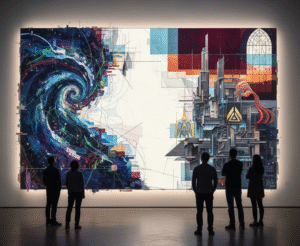
In a world drowning in literal imagery, from smartphone screens to endless social media feeds, abstract art offers a crucial escape. Its primary enduring function is as a pure conduit for emotion and thought, unburdened by narrative.
1. The Power of “Inner Necessity” (Kandinsky)
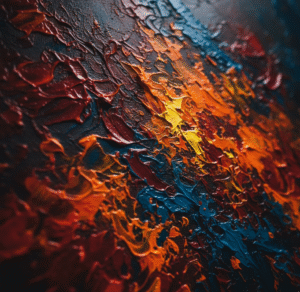
The pioneers of abstraction, like Wassily Kandinsky, argued that true art must be driven by an “inner necessity.” This concept is more important than ever. In an age where personal identity is often curated for external consumption, abstract art allows the artist to express raw, inner psychological states: anxiety, spiritual longing, ecstasy, or deep contemplation, that have no direct visual equivalent in reality.
The artist uses the fundamental elements: line, shape, color, and texture, as themselves, not as stand-ins for objects. This results in an unfiltered visual language that speaks directly from one soul to another, reinforcing its abstract art relevance as a therapeutic and honest mode of creation.
2. A Canvas for Personal Interpretation
Unlike a portrait or landscape, which guides the viewer toward a specific subject, abstract art demands active engagement. It presents a question rather than an answer, inviting an infinite array of interpretations.
This openness is a vital cultural service in the modern era. It promotes a valuable form of pluralism, acknowledging that meaning is subjective. Every viewer brings their unique life experience to the artwork, fostering a deeply personal connection that traditional art rarely achieves. This fluid interpretation ensures the artwork remains fresh and relevant with every new encounter and every passing decade, cementing why abstract art is still important.
II. Abstract Art as a Philosophical and Aesthetic Anchor
The genre’s continued relevance is also rooted in its philosophical posture and its unbreakable connection to modernist aesthetics.
3. The Minimalist Counterpoint to Digital Chaos
The digital age is defined by high definition, high volume, and high speed. Our brains are constantly processing complex, detailed, and often distracting information.
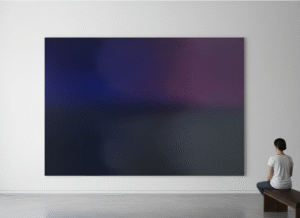
Contemporary abstract art, especially minimalist and Color Field movements (like those pioneered by Mark Rothko or Agnes Martin), offers a serene, meditative counterbalance. By focusing on vast expanses of color, subtle tonal shifts, or clean, geometric purity, it provides a visual pause: a space for slow contemplation.
In interior design, this quality is highly valued. Abstract pieces are chosen as focal points in modern homes and corporate spaces precisely because they introduce sophistication and contemplative aesthetic depth without visually cluttering the environment. This makes them highly relevant in the lucrative market of modern interior design.
4. Continuous Formal Innovation and Boundary Pushing
Abstract art has historically been the testing ground for new artistic ideas and media. Today, this spirit of innovation is thriving:
- Digital Abstraction: Artists are using generative code and Artificial Intelligence (AI) to create complex, purely non-objective digital forms, pushing the boundaries of what constitutes “painting.”
- Material Exploration: The focus remains on the materiality itself: experimenting with industrial substances, new pigments, and immersive installations that engage all senses.
By prioritizing form, process, and material over subject matter, abstract art remains firmly at the avant-garde, continually evolving and redefining the possibilities of visual art, thus solidifying its relevance in art theory and practice.
III. Cultural Integration: From Galleries to Graphics
The principles of abstraction have transcended the gallery wall to become foundational elements of the entire contemporary visual culture.
5. Shaping Modern Design and Branding
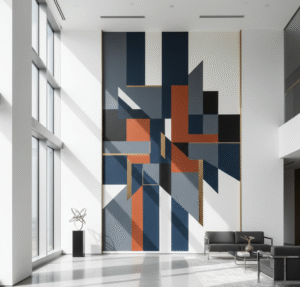
Look around, and you will see the principles of abstraction everywhere. The clean lines of modernist architecture, the emphasis on geometry in branding and logo design, and the minimal use of color in high-end product aesthetics are direct legacies of movements like De Stijl (Mondrian) and Russian Constructivism.
Abstract art relevance here is less about a specific painting and more about its contribution to a universal, refined aesthetic language: a preference for clarity, structure, and the impactful communication achieved through simplicity.
6. A Reflection of the Non-Linear World
Our modern understanding of science and reality is increasingly non-linear, fragmented, and probabilistic. From quantum mechanics to the structure of the internet, reality often defies simple, realistic representation.
Abstract art, with its fractured planes (Cubism), swirling energies (Abstract Expressionism), and spatial ambiguities, visually resonates with this contemporary understanding of the world. It provides a more authentic visual metaphor for the chaos and complexity of modern existence than a literal painting ever could.
Conclusion: The Enduring Freedom of Abstract Art
The question is no longer if abstract art is relevant, but how deeply its principles have integrated into the fabric of the 21st-century mindset.
Abstract art relevance lies in its ultimate freedom:
- Freedom for the Artist: To express the unseen, spiritual, and emotional realities.
- Freedom for the Viewer: To engage, interpret, and experience without the constraint of a prescribed narrative.
- Freedom for the Aesthetic: To evolve eternally through formal experimentation.
In a world that seeks to categorize and label everything, abstract art offers a priceless refuge: a constant reminder that the most profound human experiences often lie in the ambiguous, the indescribable, and the purely felt. It is this unwavering commitment to the essential and the elemental that ensures why abstract art is still important and will continue to be a vital artistic force for centuries to come.